Loose leaf tea asks two things of you: give the leaves room to open, and get them out of the water at the right moment. The infuser handles the second job, and it shapes the cup more than most people expect — how quickly flavor moves, whether you end up with grit in the last mouthful, and how willing you'll be to brew a second pot. There is no single best style. There is the style that suits your leaf, your mug and your habits.
Basket Infusers: The Real Workhorse
A basket infuser is a stainless steel cup with a perforated or mesh body that drops into your mug or teapot, its rim resting on the lip. Water moves through the leaves freely, and because the basket is wide, whole leaves unfold instead of being pinned against each other.
That matters more than it sounds. A silver needle or a twisted oolong can double or triple in size once wet. In a wide basket the leaves open as they would in a gaiwan; in a cramped one they stay bunched, and the cup tastes thin and sharp-edged.
Look for a basket deep enough that the tea sits fully underwater and wide enough to hold a heaped teaspoon of leaf without pressing against the lid. Fine mesh catches the small particles in fannings, broken orange pekoe and rooibos; wider perforations drain faster but let dust through. A lid that doubles as a drip tray is a small kindness on a desk.
The drawbacks are real. A basket eats mug space, so a generous 400 ml mug ends up holding 300 ml of tea. It also drips between mug and saucer if you lift it out carelessly. Narrow, tall mugs are the enemy here — check the diameter before buying.
Ball Infusers: Compact, Clumsy With Big Leaves
The two-hemisphere ball with a clasp and chain is the classic. It's simple to make, easy to store, and nearly impossible to break, which is why it turns up in office drawers and hotel rooms everywhere.
The problem is geometry. A ball holds volume but offers little surface area, and the leaves sit packed in the middle of it. Fill a typical ball halfway with a whole-leaf Darjeeling and the tea has nowhere to go; water reaches only the outer edge, and you get a cup that tastes like the idea of tea rather than the tea itself.
Balls do better with small-particle teas: CTC Assam, fannings, finely cut blends, or herbals like peppermint that are already broken into bits. Even then, resist filling it. One-third full is the practical limit — a crowded ball brews slower and harsher, not stronger.
Mesh balls beat perforated ones for particle control, though the mesh dents if you drop it. Perforated balls are sturdier but shed leaf dust into the cup. Whichever you choose, buy the largest ball you can find, then adjust your steeping time rather than crowding the leaf.
Silicone Infusers: Flexible, Convenient, Not Always Neutral
Silicone infusers — squeeze-to-open baskets, collapsible cups, silicone-lined strainers — solve the travel problem neatly. They don't rattle, they nest in a bag, they take hot water without complaint, and you can turn most of them inside out to rinse.
Two trade-offs are worth knowing. The first is flavor memory. Silicone is slightly porous, and a strainer that held a smoky lapsang or a jasmine blend can carry that scent into your next plain green tea for a while. A baking soda soak helps; keeping a separate strainer for smoked and spiced teas helps more. The second is body. A soft silicone basket can be squeezed, and squeezing wrings tannins out of the leaves, which reads as bitterness.
A note on materials
Choose food-grade, heat-safe silicone from a maker that states it on the packaging. Silicone sold for baking is generally fine at brewing temperatures, but unlabeled bargain-bin items are a gamble. If you'd rather not think about it, stainless steel or glass is the conservative default. Baskets with a stainless mesh floor and a silicone frame are a good middle ground — the leaves meet metal, and the soft frame handles the mess.
Matching the Infuser to the Leaf
- Whole-leaf oolongs, silver needle, large-leaf blacks: a wide stainless basket, or brew in a small pot and pour through a separate strainer.
- Broken-leaf blacks, fannings, CTC: fine-mesh basket or a mesh ball.
- Rooibos, honeybush, peppermint: fine mesh, since these are dusty by nature.
- Chunky herbals and flowers: chamomile, rose, cinnamon bark — use a basket so the pieces have room to move.
- Flavored blends with fruit or sugar crystals: a basket, rinsed straight after use, because sticky pieces set like glue.
- Office and travel: a large mesh ball or a silicone basket, plus a small tin of leaf.
Four Checks Before You Buy
- Depth over width. Measure the interior of your favourite mug. A basket that leaves the top third of the leaf above water will brew weakly no matter how good your tea is.
- Hole size against your usual leaf. If you drink mostly fannings, fine mesh is non-negotiable. If you drink whole leaf, slightly larger holes drain faster and rinse cleaner.
- Rim fit. A basket should sit on the lip, not wedge into it. Anything that wobbles will tip when you pour.
- One-handed opening. Clasps that need two hands and a flat surface get abandoned fast on busy mornings.
Cleaning Habits That Keep Tea Tasting Right
Rinse every infuser with hot water as soon as you empty it; dried leaf sets like cement in mesh. Once a week, soak metal baskets in a cup of hot water with a spoonful of baking soda to lift the brown tannin film, then scrub the mesh with an old soft toothbrush. Skip the dishwasher for anything with a hinge or a thin wire rim. And never store an infuser damp in a closed drawer — that's how it acquires the smell of last month's Earl Grey.
A Sensible Starting Point
If you drink mostly whole leaf and have one mug you love, buy a stainless basket that fits it properly and stop there. Add a large mesh ball for travel, and a silicone basket only if you genuinely need something that folds flat. The tool is not the tea. But the right one gets out of the way, and that's exactly what you want from it.
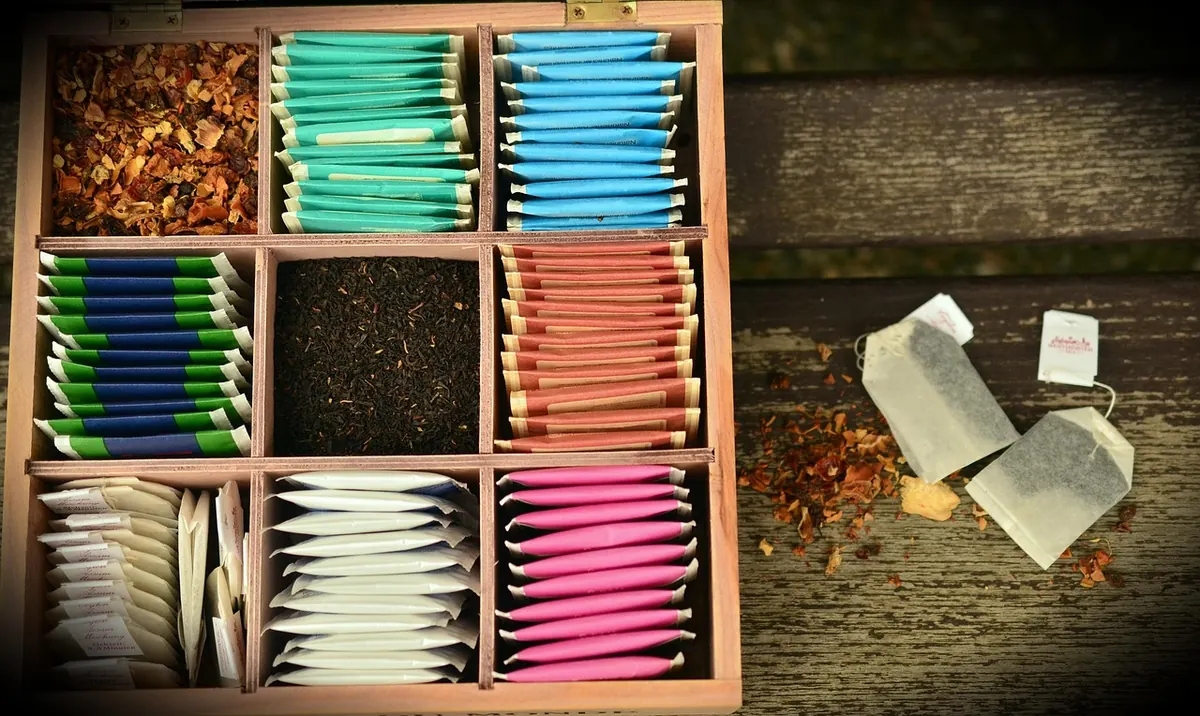
Photo: congerdesign / Pixabay