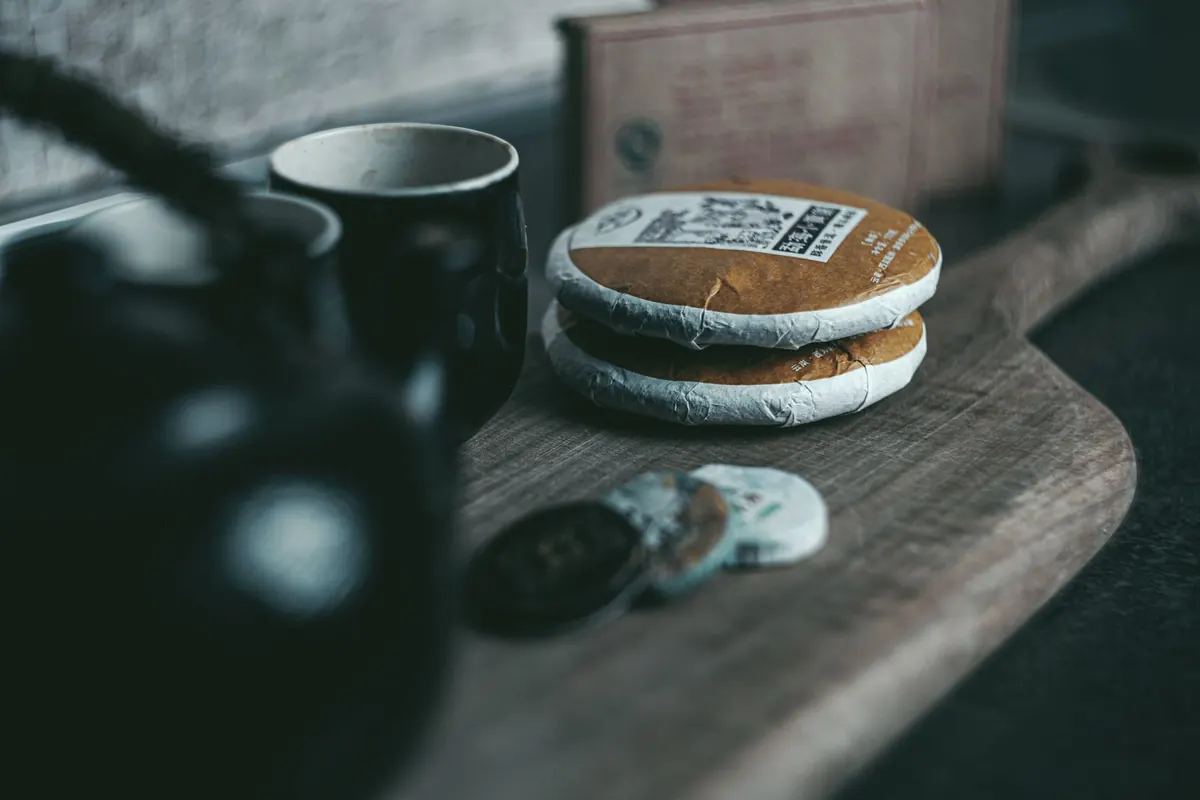
Pu'er is the tea that behaves least like tea. It comes pressed into dense cakes you pry apart with a pick, it smells like a forest floor one day and dried apricots the next, and it's one of the few teas people buy young and deliberately leave alone for a decade. If your reference point is a supermarket teabag, the first cup can be a surprise. It can also be the start of something you keep coming back to.
What Pu'er Actually Is
Pu'er comes from Yunnan province in southwest China and is made from the large-leaf variety of the tea plant rather than the small-leaf bushes behind most green and black teas. The leaves are processed into maocha, a sun-dried unfinished tea, which is then sold loose or steamed and compressed into shapes.
There are two families to know: sheng (raw) and shou (ripe, sometimes called cooked). Both start from the same maocha. What separates them is time, and in the ripe style, a deliberate fermentation step.
You'll see pu'er in a few traditional forms:
- Bing cha — a flat round cake, traditionally about 357 grams
- Tuo cha — a small bird's-nest shape, often sold singly
- Zhuan cha — a brick, common in older trade teas
- Loose maocha — uncompressed leaf, easy to brew and ideal for sampling
Raw Pu'er: The Slow Route
Sheng is essentially a green tea that keeps developing. Young raw pu'er, anything under about five years, is brisk and often quite bitter, with notes of hay, orchid, young stone fruit, and honey. That bitterness isn't a fault if it dissolves into sweetness. The good sign is hui gan: the sweetness that returns to your mouth and throat after you swallow.
Leave a raw cake alone for ten or twenty years and it changes. The liquor deepens from pale gold to amber to dark ruby, the sharp edges round off, and dried fruit, camphor, old wood, and something faintly medicinal begin to appear. Aging doesn't guarantee improvement — mediocre leaf stored badly just becomes old mediocre leaf — but well-stored sheng is why people get obsessive about pu'er.
Ripe Pu'er: The Fast Track
Waiting twenty years isn't practical for a tea factory, so in the 1970s producers found a way to speed things up. Maocha is piled, dampened, covered, and turned over several weeks in a step called wo dui, or wet piling. Microbial activity does in a couple of months what would otherwise take decades.
The result is dark, smooth, and low in bitterness: dark chocolate, cocoa, damp earth, sweet potato, raisins, wood. Ripe pu'er is drinkable the day you buy it and doesn't change dramatically afterwards, so there's no reason to hoard it. Very young ripe tea can carry a musty "pile" smell that fades over months to a couple of years, so if your first ripe tastes like a wet basement, try another before writing off the whole category.
Storage: What Matters and What Doesn't
If you plan to age raw pu'er, storage is the whole game.
- Keep it stable. A closet away from windows and radiators beats a shelf above the stove.
- Aim for moderate humidity. Many drinkers target roughly 60–70% relative humidity. Too dry and the tea stalls; too wet and it can sour or mould.
- Let it breathe a little. A cardboard box in a cupboard is enough. Don't vacuum-seal a cake for a decade, and don't leave it bare on an open shelf either.
- Avoid smells. Spices, coffee, soap, and cleaning products all end up in your tea.
- Store raw and ripe separately. They trade aromas, and ripe usually wins.
- Skip the fridge. That's for greens.
One practical note: pu'er contains caffeine and is a strong tea. If you're sensitive to caffeine, pregnant, or taking medication, check with a doctor or pharmacist before making it a daily habit. Claims about pu'er and weight loss or digestion are best treated with scepticism.
How to Brew It Without Fuss
You don't need a tea table or a shelf of clay pots. A gaiwan or small teapot, a kettle, and a strainer will do.
- Use about 5 grams of leaf per 100–120 ml of water. Ripe tea takes slightly less; young raw slightly more if you like intensity.
- Use water just off the boil, or fully boiling. Pu'er is not delicate.
- Rinse the leaf: one quick pour, five seconds, then discard the water. Ripe tea often benefits from two rinses.
- Steep short — start at 5–10 seconds and add 5–10 seconds each round.
- Pour it all off. Water left sitting on the leaf makes the next cup bitter.
- Keep going. Ten to fifteen infusions from the same leaf is normal.
What to Try First
A sensible order, cheapest and most forgiving first:
- A ripe tuo or small ripe cake, 3–5 years old. This tells you quickly whether earthy, dark flavours appeal to you.
- A young raw sheng, 2–5 years old. Brew it light at first so the bitterness doesn't overwhelm you.
- An aged raw sample, 10+ years. Buy 10–25 grams rather than a whole cake. This is the flavour most people are chasing.
- A side-by-side comparison. Same leaf weight, same water, one ripe and one raw. The differences become obvious fast.
As you taste, pay attention to four things: bitterness, sweetness, texture (thick or thin in the mouth), and how long the aftertaste lingers. Write a line about each. In two years those notes will be more useful to you than any review you read.
Buying Without Getting Burned
Start with samples, always. Twenty-five to fifty grams is enough to judge a tea and cheap enough to walk away from. Ask the vendor for the year, the region, and who made it. If they can't tell you, keep looking.
Price is not proof of quality, and famous village names get copied constantly. Established factory recipes make a useful benchmark while you're learning: classic numbered blends such as
Photo: Ahimsa - OM / Pexels